Trade Promotion Management & Optimisation (TPM & TPO)
Plan, fund, reconcile and optimise trade promotions in one place, and improve the return on your trade spend.
Know what every trade dollar returns, and where to spend the next one
- TPM: replace spreadsheets and automate planning, funding, budgeting, reconciling and monitoring promotions.
- TPO: price elasticity and cannibalisation modelling, what-if scenarios and optimisation against trading terms and market share objectives.
- Revenue growth management: data-driven plans and negotiations that improve outcomes across the supplier–retailer value chain.
For many consumer goods companies, trade promotions are the second-largest item on the P&L after cost of goods sold, yet few know what they get back for that spend. Plans are often built in home-grown spreadsheets by taking last year's plan and tweaking it, so promotions fail to deliver the ROI they should. Digitalising and optimising this process involves two different kinds of software:
- Trade Promotion Management (TPM) replaces spreadsheets and automates the transactional workflow of planning, funding, budgeting, reconciling and monitoring promotions.
- Trade Promotion Optimisation (TPO) adds advanced analytics, such as price elasticity and cannibalisation modelling, to explore what-if scenarios and optimise promotional programs against constraints like trading terms and market share objectives.
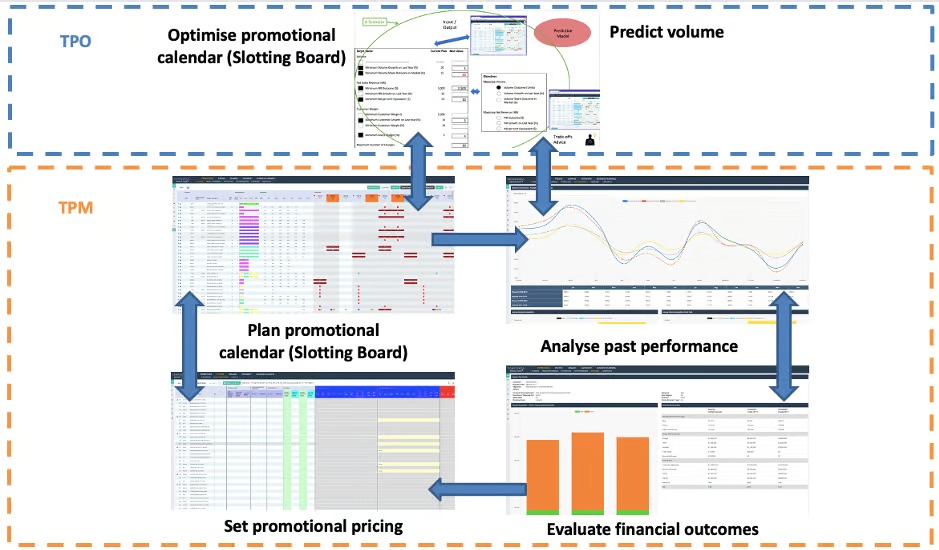
For companies wanting to replace the home-grown spreadsheets and automate the labour-intensive processes for data loading and handling, customer planning and budgeting, TPM is usually the starting point. Complexica's Trade Promotion Management (TPM) system can be used by a broad range of users – such as merchandisers, category teams, trade marketing, strategy and customer finance – for their transactional workflows associated with planning, managing (funding, budgeting and reconciling promotions) and monitoring promotional activities.
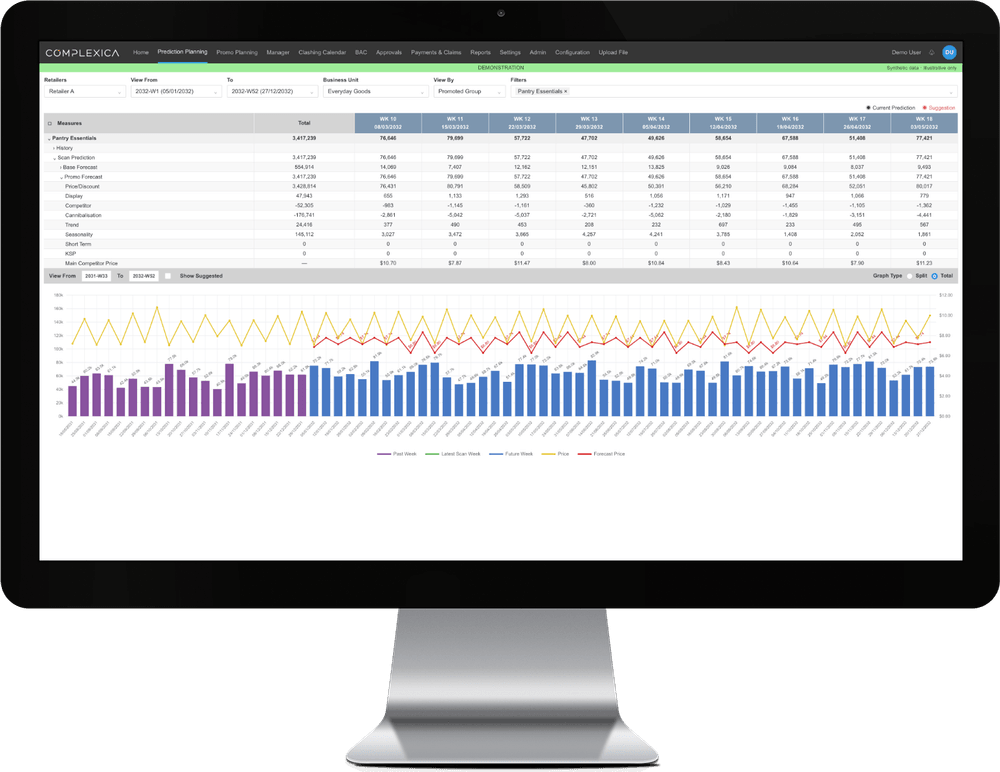
Complexica's Trade Promotion Optimisation (TPO) system, on the other hand, can enable advanced analytics around price elasticity and cannibalisation, as well as optimisation and what-if predictive modelling capabilities. TPO allows users to explore countless what-if scenarios, as well as run optimisation algorithms against various objectives and constraints, such as trading terms constraints, market share objectives, promotional guardrails, supplier constraints, category growth objectives, and more. The table below distinguishes between the two types of functionalities:
| Functionality | Trade Promotion ManagementTPM | Trade Promotion OptimisationTPO |
|---|---|---|
| Tactical management of trade promotions | Yes | Not applicable |
| Strategic management of trade investments | Not applicable | Yes |
| Predictive analytics with what-if scenarios | Not applicable | Yes |
| Transaction management (settling claims, clearing deductions etc) | Yes | Not applicable |
| Post-event analysis | Yes | Yes |
To perform their optimisation workflow, TPO systems extract data (both transactional data as well as promotional slotting boards) from TPM systems and then push back optimised promotion plans that deliver the right mix of category growth and sustainable share. Given the complexity of the business problem and the algorithmic techniques involved, it's important to note that no two deployments are the same. The algorithmic techniques are trained on each client's data, and the various constraints/objectives used by the optimiser are configured to each client's needs.
Deployment and benefits
Depending on business requirements, TPM and TPO components can be deployed together or in isolation. Key benefits include:
- Reduced time and labour required for creating new promotional plans
- Improved ROI on trade spend
- Better outcomes across the supplier-retailer value chain, as well as overall category
- Data-driven decisions and negotiations, leading to improved supplier-retailer relationships
Learn more
Common questions
Can we start with one module?
Yes. Decision Cloud® is fully modularised, so you can start with the module that solves today’s problem (for example pricing, promotions or demand planning) and add others as you grow. Every module runs on the same AI engine and the same data.
How long does implementation take?
It depends on the scope. Every engagement starts with a no-cost workshop, followed by a fixed-price, fixed-time scoping engagement that defines the deployment milestones, cost estimates and business benefits. Deployments are then staged rather than “big bang”, which reduces risk and brings forward the return on investment. See our frequently asked questions for each stage of the engagement model.
Which ERP systems do you integrate with?
Decision Cloud® has a set of standard integration APIs for common ERP systems and platforms, as well as public data sources such as the Australian Bureau of Statistics and the Bureau of Meteorology. The specific interfaces for your systems are defined during the scoping engagement.
More: TPM vs TPO - what is the difference? and other questions in our FAQ.
Some of our Customers










Some of our Recent Awards