Integrated Planning & Scheduling Optimiser
Production, maintenance, equipment and labour schedules built around your real business rules and constraints, and re-optimised as demand and other conditions change.
Schedules that re-optimise when the plan changes
- Higher DIFOT, less work-in-progress and finished goods inventory.
- Trade-offs made visible: set multiple objectives and compare scenarios financially.
- Less planning time: centralise planning and scheduling across plants and production stages.
For complex planning & scheduling activities – especially those that are heavily constrained or require multi-stage scheduling and frequent re-scheduling – our experience is that off-the-shelf software packages just don't work. Because of the many differences between problem types and industries, you often end up with a rigid system with pre-set objectives, logic, and scope, which doesn't quite fit your core operation.
Because our Integrated Planning & Scheduling Optimiser module of Decision Cloud® is tuned to your specific business rules, constraints and processes, it can be used to optimise a wide variety of planning & scheduling activities, including production, maintenance, equipment and labour – allowing you to dynamically create schedules that are optimised for cost, profit, utilisation, or customer-defined objectives (such as service levels, etc.)
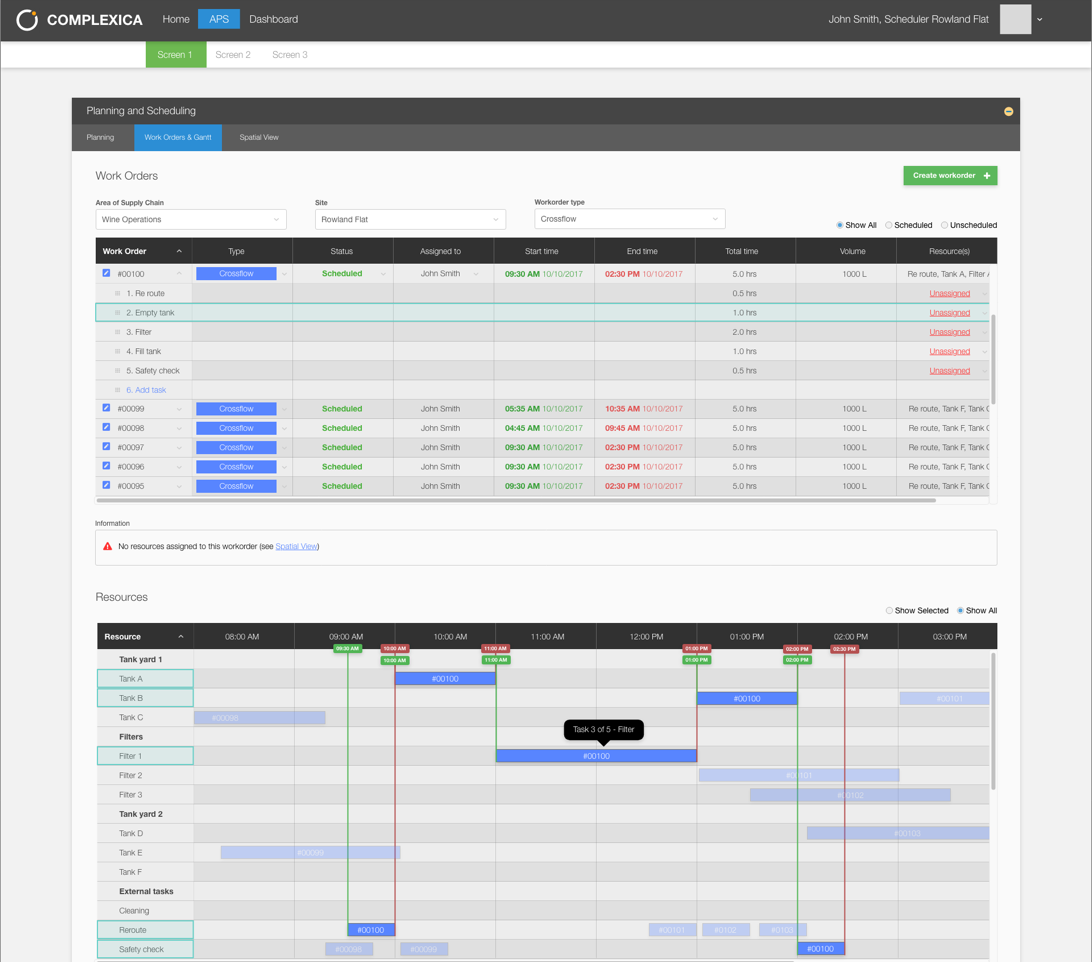
The benefits of integrated planning, scheduling, and optimisation are numerous, including:
- Increased delivery on time and in full (DIFOT)
- Reduced work-in-progress and finished goods inventory
- Reduced planning time
- Ability to dynamically re-optimise around unexpected changes in demand and other events
- Ability to conduct financial what-if analysis and scenario comparison
- Ability to set multiple objectives/goals and analysing the trade-offs
- Centralising the planning and scheduling function across multiple plants
- Optimising across multiple production stages or steps
- Evaluating the impact of business rules, process, and constraint changes
Learn more
Discover why Pernod Ricard selected Complexica to globally optimise its supply chain operation
Common questions
Can we start with one module?
Yes. Decision Cloud® is fully modularised, so you can start with the module that solves today’s problem (for example pricing, promotions or demand planning) and add others as you grow. Every module runs on the same AI engine and the same data.
How long does implementation take?
It depends on the scope. Every engagement starts with a no-cost workshop, followed by a fixed-price, fixed-time scoping engagement that defines the deployment milestones, cost estimates and business benefits. Deployments are then staged rather than “big bang”, which reduces risk and brings forward the return on investment. See our frequently asked questions for each stage of the engagement model.
Which ERP systems do you integrate with?
Decision Cloud® has a set of standard integration APIs for common ERP systems and platforms, as well as public data sources such as the Australian Bureau of Statistics and the Bureau of Meteorology. The specific interfaces for your systems are defined during the scoping engagement.
More: Why is AI well suited for supply chain optimisation? and other questions in our FAQ.
Some of our Customers












Some of our Recent Awards